
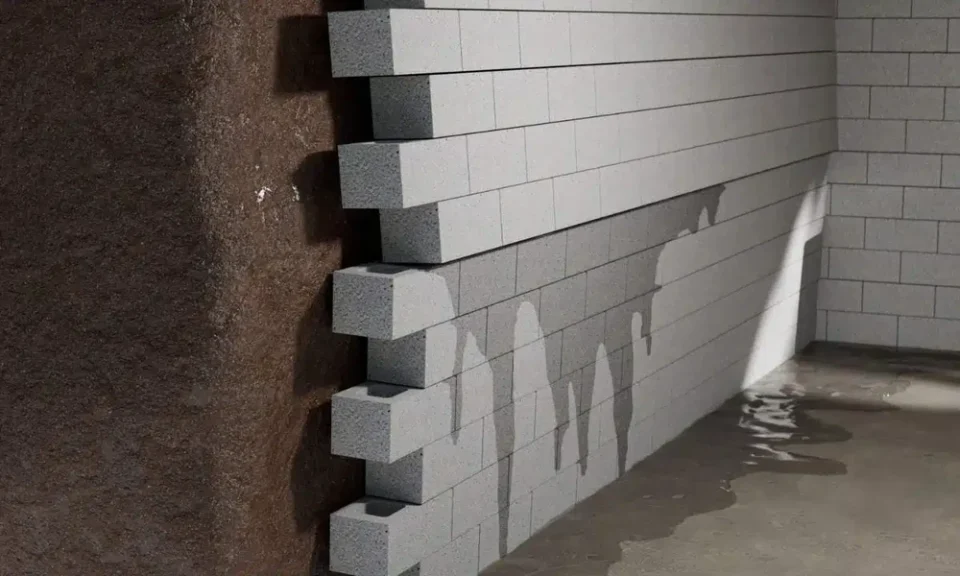
Three inches. That’s how far one Lincoln homeowner let her basement wall lean in before she called anyone, because for two years the movement was slow enough to ignore. The crack behind her laundry sink told a different story. Foundation walls rarely fail overnight. They lean, crack, and shift over many freeze and thaw cycles, and the repair bill grows with every season you wait.
Here’s the good news: a bowing wall caught early is far easier to fix than most people fear. You don’t need to guess whether the lean is cosmetic or structural. Below is what actually pushes a wall inward, what to measure before you panic, and how contractors pull a wall back to plumb.
What Actually Pushes a Wall Inward
Most bowing starts with soil, not concrete. A basement wall is designed to hold back dirt, but it is not designed to hold back saturated dirt plus expanding clay plus the weight of a driveway sitting eight feet above it. When the soil around your house soaks up water and swells, that pressure has to go somewhere, and the path of least resistance is your wall.
Clay is the usual suspect across the Midwest. It expands when wet and shrinks when dry, which means your wall gets shoved and released, shoved and released, year after year. Frost makes it worse by trapping water in the soil and expanding it further. Meanwhile, a clogged gutter or a downspout that dumps right against the foundation keeps feeding the problem every time it rains.
Chronic water pressure is also why so many bowed walls show up alongside a wet basement, so it pays to understand how bowing foundation wall repair in Lincoln contractors connect drainage work to structural work rather than treating them as separate jobs.
Reading the Warning Signs Before They Get Expensive
Your wall will tell you what’s happening long before it fails. You just have to look in the right places.
- Horizontal cracks in the middle third of the wall, which usually point to soil pressure rather than settling.
- A visible lean when you sight down the wall from one corner to the other.
- Stair-step cracks at the corners, where two walls meet.
- Doors and windows upstairs that suddenly stick or won’t latch.
- Bowed sections you can feel by laying a level or a straight board against the wall.
Vertical cracks are common and often just shrinkage. Horizontal ones are the ones that make me nervous. If you can slide a coin into a horizontal crack in the middle of your wall, get it looked at this season, not next spring.
One practical trick: tape a strip of masking tape across the widest crack and date it with a marker. Check it monthly. If the tape stretches or tears, the movement is active. That single strip of tape gives an inspector more useful information than any photo you could take.
When to Call Someone and When to Watch
Not every crack needs a crew. Hairline cracking under a quarter inch that shows no movement is usually a monitoring situation. Call a professional when you see any of these:
- The wall leans more than about an inch across its height.
- Movement is active, confirmed by your tape test.
- You can see daylight or feel air moving through a crack.
- The wall is bowing and the floor above feels uneven.
- Water is entering at the same spot every storm.
Inspection is usually free or low cost, and it settles the question fast. Most contractors will measure the deflection, note the crack pattern, and tell you honestly whether you’re looking at a monitoring situation or a repair.
How Bowing Walls Actually Get Fixed
Repair methods fall into two groups: those that stop the wall from moving further, and those that push it back toward straight.
Carbon fiber straps are the least invasive option. Crews epoxy horizontal straps across the bow on the interior face, and they hold the wall where it is. They work well on walls with minimal deflection, but they stop movement rather than reverse it.
Wall anchors reach out into the yard and tie the wall to a plate buried in stable soil. A rod runs through the wall, and over weeks or months, the crew tightens it. This is the method that can actually pull a leaning wall back toward plumb, and it’s what I’d choose for a wall leaning more than two inches.
I-beams are the heavy solution for badly bowed walls or block walls cracking apart. Steel beams sit vertically against the wall, anchored top and bottom. They’re ugly and they eat floor space, but they don’t care how much soil pressure shows up.
Every one of these approaches depends on fixing the water first. Bracing a wall against soil that keeps swelling is like holding a door shut against someone who never stops pushing. Grading, gutters, downspout extensions, and interior drainage all reduce the load the wall has to survive.
It also helps to know what you’re up against regionally. According to the Federal Emergency Management Agency, flooding remains the most common and costly natural disaster in the United States, and much of the damage comes from water finding weak points rather than from dramatic events. A bowed wall with a crack is exactly that kind of weak point.
A Simple Seasonal Walkthrough
You can protect your foundation with about fifteen minutes twice a year. Fall and spring are the right times.
Start outside. Walk the perimeter and look at the ground. It should slope away from the house, not toward it. Clear leaves from gutters and confirm downspouts carry water at least a few feet from the wall. Look for soil that has pulled away from the foundation, which can signal movement underneath.
Move inside. Sight along each basement wall and look for new cracks or a lean you hadn’t noticed. Check the tape you dated. Look for efflorescence, that chalky white residue that means water is moving through the concrete.
Then check the upstairs. Doors and windows that stick in one season and free up in another are a clue that something below is moving. Homeowners often blame humidity. Sometimes they’re right. Sometimes the foundation is the real cause.
Repair costs climb fast once a wall moves past a certain point, and insurance rarely covers gradual ground movement. According to the Insurance Information Institute, standard homeowners policies generally exclude damage from earth movement, which is why catching this early is a financial decision as much as a structural one.
What I’d Do If It Were My Basement
I’d skip the wait and see approach past the one inch mark. Here’s the sequence I’d follow: tape and date the widest crack today, fix the drainage within a month, get one inspection with actual measurements, and then choose a repair based on how far the wall has moved rather than on which method is cheapest. Straps on a wall leaning three inches are a waste of money. Anchors cost more up front and can actually correct the problem.
It’s also worth remembering that repairs hold up better when drainage works properly afterward. New gutters are cheaper than a second round of structural work, and they protect whatever repair you just paid for.
Foundation movement is one of the few house problems that rewards patience with more expense. The wall isn’t going to straighten itself out, and the soil behind it isn’t going to stop swelling. Get the measurements, fix the water, and let a qualified contractor tell you what the numbers say. If you’re in eastern Nebraska and your wall has started to lean, a free estimate will answer in an hour what another winter of guessing won’t.
