
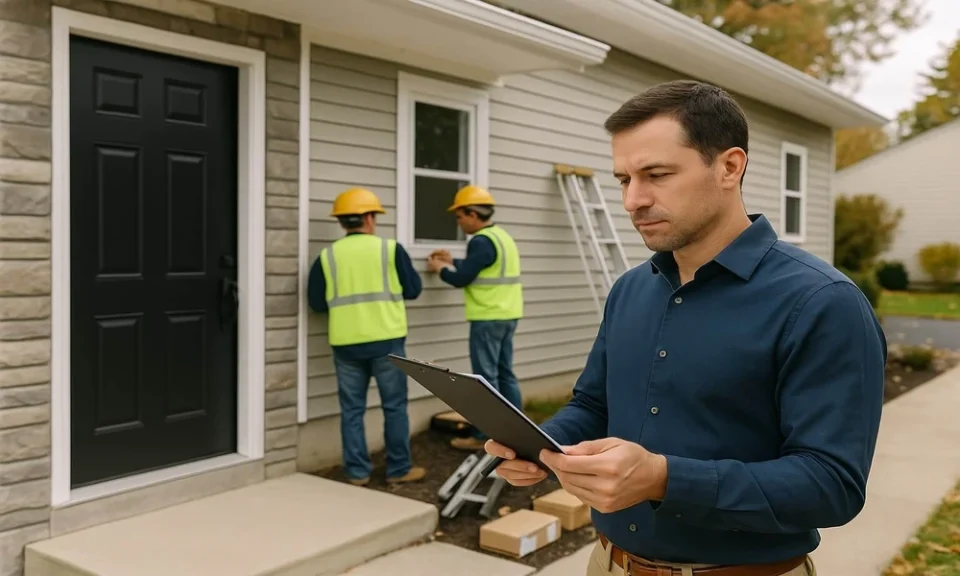
Most homeowners spend months agonizing over kitchen countertops or bathroom tile while the single highest-return upgrade sits right at the end of their driveway. Your front door. Not a renovation. Not an addition. A door. And the return on that investment, according to industry benchmarks, regularly beats projects that cost five times as much.
This isn’t a design argument. It’s a financial one. But understanding why a door punches so far above its weight helps you make a smarter choice about material, style, and timing – before you spend a dollar.
The Numbers That Should Stop You Mid-Kitchen-Remodel
Every year, the Journal of Light Construction publishes its Cost vs. Value report, comparing what homeowners spend on remodeling projects against what those projects actually return at resale. The 2024 edition made the home improvement industry pay attention. The project with the highest average national ROI, outside of garage door replacement, was exterior door replacement, which came in at 188% ROI. That figure landed ahead of every interior remodel tracked in the study.
Read that again with a dollar sign in mind. With an average project cost of $2,435 and a resale value of $5,270, replacing existing entry doors with new 20-gauge steel doors delivered a 216% ROI in certain regional markets. You spend roughly $2,400 and add more than $5,000 to your home’s value. No kitchen reno, no master bath expansion, no composite deck comes close on that ratio.
The comparison table below puts this in perspective.
| Home Improvement Project | Avg. National ROI (2024 CVV Report) |
|---|---|
| Garage Door Replacement | 194% |
| Steel Entry Door Replacement | 188% |
| Manufactured Stone Veneer | 153% |
| Minor Kitchen Remodel | 96% |
| Window Replacement (Vinyl) | 67% |
Source: Journal of Light Construction 2024 Cost vs. Value Report
The minor kitchen remodel sitting at 96% feels solid until you put it next to 188%. You’re doing twice as much work, spending considerably more, and getting almost half the proportional return. That’s a hard case to make.
Why the Market Shifted So Dramatically Toward Curb Appeal
The 2024 ROI numbers didn’t come out of nowhere. Zonda Advisory principal Todd Tomalak explained the trend directly: a strong shift toward move-up buyers, who are more discerning than first-time buyers, combined with fewer existing homes meeting that quality standard, means a new entry door can make a pronounced difference and could be the thing that makes one house stand out against all the others.
“A new garage door or new entry door can make a pronounced difference. It could be the thing that makes one house stand out against all the others, making the home worth a higher price.”
– Todd Tomalak, Principal, Zonda Advisory, as reported in the Builder Online 2024 Cost vs. Value Report analysis
Buyers form their opinion of your home before they get out of the car. That’s not a soft, feelings-based claim – it’s what real estate professionals price into their valuations. A tired, faded door signals deferred maintenance. A solid, well-crafted door signals exactly the opposite.
The Door Decision Matrix: How to Pick the Right Material for Your Climate
Here’s a framework I’d call the Door Decision Matrix, built around two variables most buyers ignore: climate severity and directional exposure. Both matter more than aesthetics when you’re choosing a material that has to perform for decades.
Picture a west-facing entry in Phoenix in July. The surface temperature of the door hits 140 to 150 degrees Fahrenheit by mid-afternoon. In desert climates like Arizona, extreme heat, intense sunlight, and low humidity can cause materials like wood to shrink, crack, and warp over time. Wood needs constant refinishing, special sealing, and still fights a losing battle against that sustained UV load. Fiberglass performs better but carries its own desert liability: in Arizona, relentless UV exposure causes fiberglass resin to yellow, chalk, and grow brittle over time, and a brittle panel cracks at stress points where steel would simply flex.
Steel and iron, properly coated and foam-insulated with a real thermal break, are built for exactly this punishment. They don’t expand and contract with moisture cycles because Arizona’s desert air keeps humidity minimal. They don’t yellow. They don’t chalk. And when the design is custom-fabricated rather than pulled from a catalog, they hold their finish and structural integrity for decades with minimal upkeep.
The matrix works like this:
- Wood: Best under covered entries with no direct sun. Needs regular maintenance. Lowest ROI over a 30-year horizon in hot climates.
- Fiberglass: Works well in moderate climates. Underperforms in sustained desert UV. Good for north or east-facing entries in Arizona if you commit to finish maintenance.
- Steel or custom iron with foam insulation and thermal break: The strongest choice for south- and west-facing desert entries. Highest structural durability, best ROI data, and the only material that genuinely improves with a custom design upgrade.
If your home is in the Sonoran Desert and your door faces afternoon sun, the matrix points one direction. That’s not a sales pitch – it’s physics.
What “Custom” Actually Means (and Why the Difference Is Obvious from the Street)
The word “custom” gets abused in this industry. Most manufacturers use it to describe a standard door with an optional color. Real custom fabrication means the design is built around your opening, your architecture, and your aesthetic – then hand-finished to spec.
Custom iron doors start the conversation at 12-gauge steel frames, fully insulated panels, operable glass with working screens, and finishing that doesn’t crack or peel when surface temps spike. Companies like Iron Doors Arizona pair that construction with design consultation so you’re not just buying a door – you’re building an entryway that fits the exact character of the home. That integration matters at appraisal time, and it’s visible from the curb in a way that a stock door never is.
The practical difference shows up in three ways. First, proportion: a custom door sized and styled to your facade looks intentional, not installed. Second, glass placement: integrated glass panels and sidelights bring natural light into the entry without sacrificing security, which is a feature buyers notice and agents mention. Third, hardware: a custom door’s hardware weight, finish, and lock quality communicate quality even before anyone steps inside.
The Timing Question: When Should You Actually Do This?
If you’re planning to sell within three years, do this before any interior project. The ROI data is clear, and buyers respond to it emotionally even when they can’t articulate why. If you’re staying put for a decade, the calculation is different but still favorable – you’re trading years of a beautiful, low-maintenance, energy-efficient entry for a price that’s almost certain to come back to you in full at resale.
One practical note: plan your installation a full season ahead of any listing. You want the door to weather its first monsoon season (if you’re in the Southwest) before buyers see it, confirming that it performs exactly the way it looks – solid, sealed, and unaffected by heat.
The question worth sitting with isn’t whether a door upgrade is worth doing. The data settled that. The question is whether the door you’re planning matches the climate it’ll face every single day. Choose the material that answers that question honestly, and the ROI will take care of itself.
